Modern life is noisy. We're bombarded with notifications, short-form videos, social media updates and an endless stream of information competing for our attention. Add the proliferation of misinformation into the mix, and getting important, potentially life-saving messages in front of the public is arguably harder than ever.
There was a time when an announcement on the television news or a presenter discussing an unfolding situation on local radio could reach a significant proportion of the population. Those channels remain important, but audiences are now fragmented across more platforms and services than ever before.
So how do you reach millions of people, quickly and reliably, when something genuinely important happens?
Enter the UK's Emergency Alerts system.
A message from March 2020
I've been interested in emergency broadcasting for some time. During my first visit to the United States, their mobile alert system highlighted a glaring omission in the UK's infrastructure. We had television and radio, but no nationwide system to broadcast directly to people's phones.
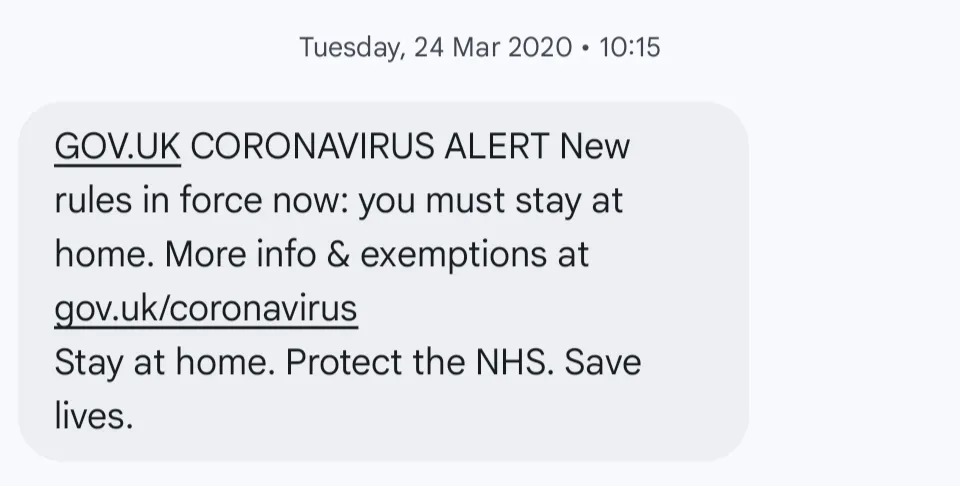
That gap became obvious in March 2020. Following the announcement of the first COVID-19 lockdown, the Government had to rely on mobile operators to send conventional text messages. As BBC News reported at the time, O2 was sending messages in batches, with some potentially not arriving until 22:00 that evening. I guess I was lucky, as I received mine at 10:15 on 24 March 2020, the morning after the first lockdown was announced.
More importantly, it was just another text message. Phone on silent? You wouldn't hear it. Busy inbox? It easily got lost.
Filling a gap in public infrastructure
When the UK Government launched its Emergency Alerts system in 2023, I was pleased to see this gap being addressed.
Unlike conventional SMS, the system uses cell broadcast technology to transmit warnings through mobile phone masts to compatible devices within a geographical area.
There's no need to know individual phone numbers, download an app or subscribe to anything. Crucially, the warning can trigger a distinctive siren-like sound and vibration, even when the phone is set to silent.
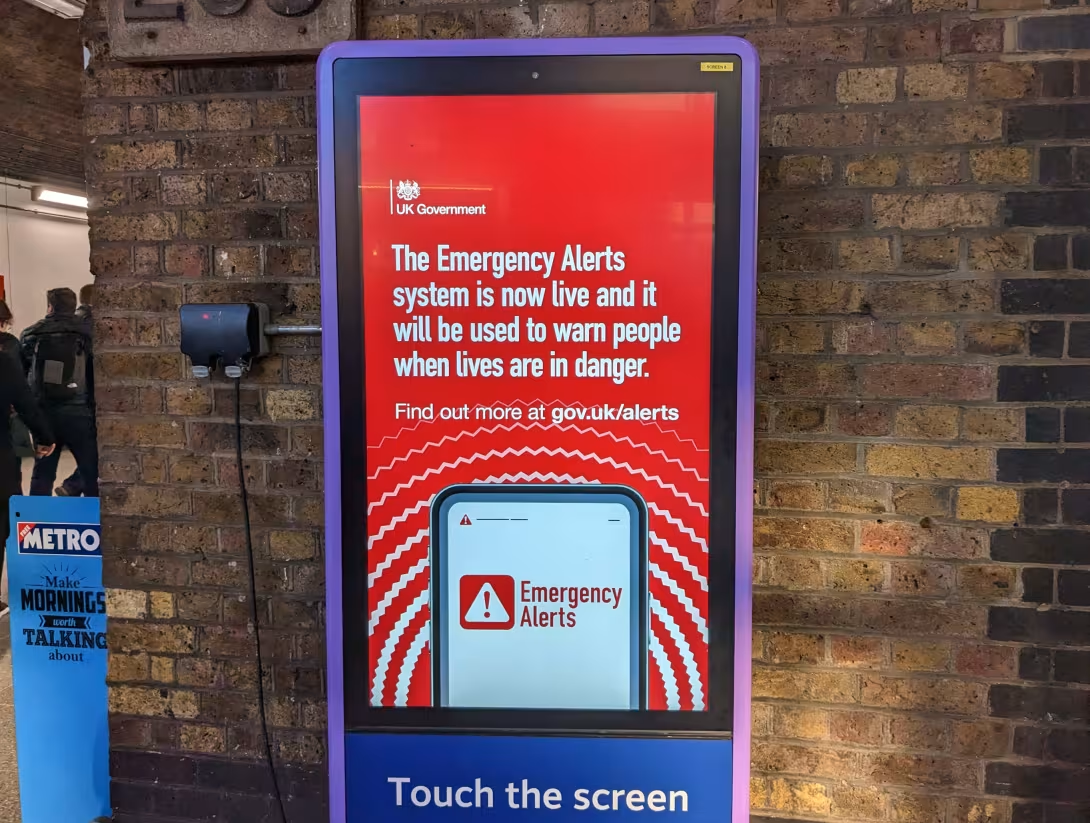
I remember photographing a Government advertisement for the service at London Waterloo in 2023 (you can see this photo at the top of this page). Its message was straightforward:
"The Emergency Alerts system is now live and it will be used to warn people when lives are in danger."
Clear, easy to understand and difficult to argue against.
Flooding, extreme weather, wildfires and other threats to life are precisely the situations where reaching people quickly can make an enormous difference.
Which brings me to August 2026.
The alert that got me thinking
At 19:01 on 14 August 2026, an Emergency Alert was broadcast across England and Wales warning of a very high risk of wildfires. My phone displayed a "Severe alert," accompanied by the unmistakable siren.
It certainly grabbed attention. It even interrupted BBC One’s The One Show live on air, leaving the presenters initially wondering if the noise was the studio's fire alarm.
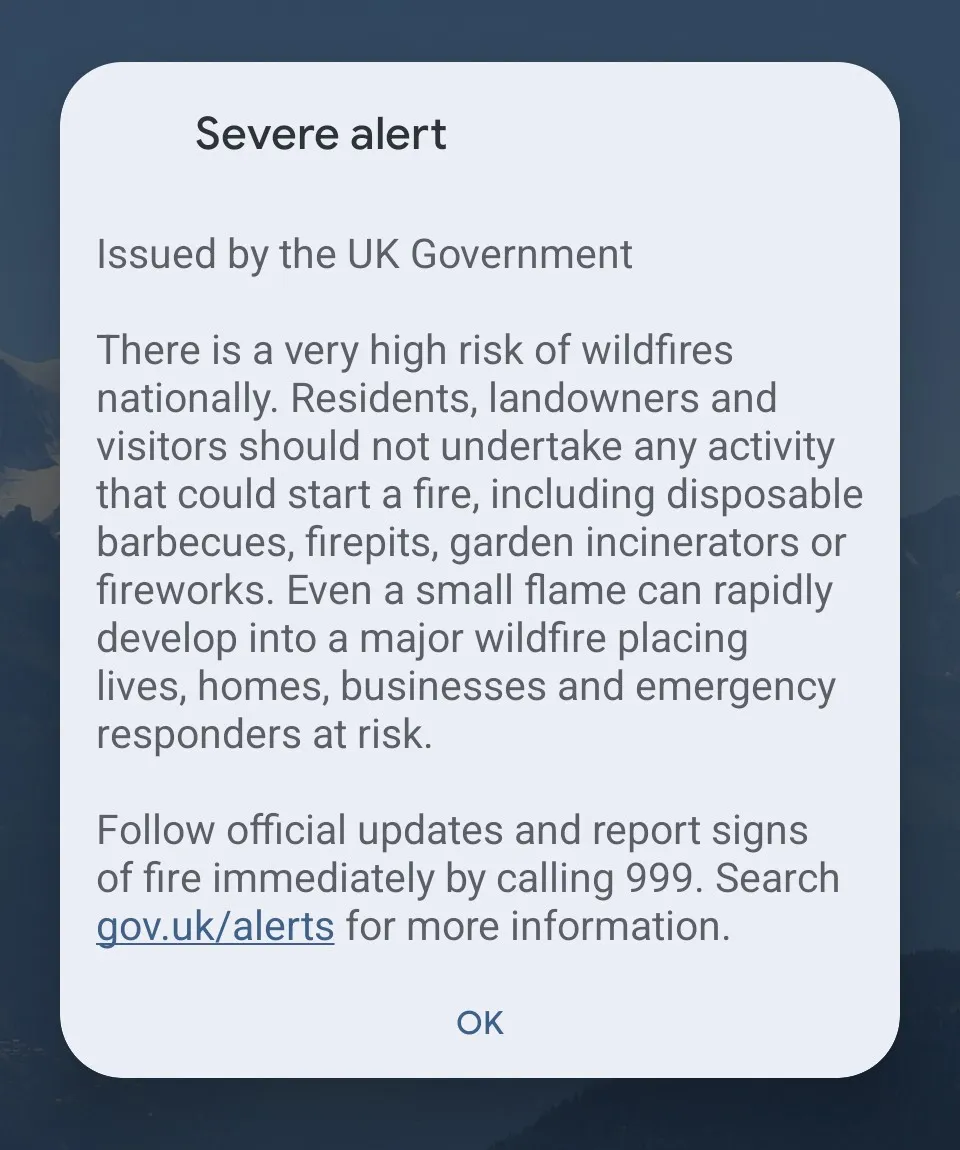
But when I read the message, something didn't sit quite right.
The wildfire risk was undoubtedly serious, with emergency services stretched across 43 active fires and 11 major incidents. Yet, for the vast majority of recipients, there was no immediate fire threatening their home, nor an instruction to evacuate. Instead, the message was preventative, asking people to avoid using disposable barbecues or firepits.
It was important public safety advice. But was it an immediate emergency requiring everyone to stop what they were doing?
The risk of alert fatigue
In digital product design, communication hierarchy is vitally important. For example, an action camera's routine software update may give the user a subtle nudge; a critical SD card read / write failure would be expected to interrupt the user's entire experience. Every message can't be treated as equally urgent, because doing so undermines the system.
The US approach to Wireless Emergency Alerts reflects this, distinguishing between imminent threats and public safety messages. The UK system, however, demonstrated that a preventative message can still trigger the exact same intrusive, siren-like experience associated with an immediate threat to life.
My concern isn't the wording of the August alert. Preventing another major incident undoubtedly saves lives. My concern is alert fatigue.
An Emergency Alert’s power lies in its ability to demand immediate attention. If we repeatedly use the same loud siren for preventative advice and immediate threats, I worry we risk diluting its impact.
There are also real-world consequences beyond inconvenience: Women's Aid raised concerns ahead of the 2023 nationwide test about the safety of survivors keeping a phone hidden from an abuser.
Finding the right balance
I want the UK's Emergency Alerts system to succeed. Having seen the limitations of mass SMS during the COVID pandemic, this system is a vital upgrade.
The Government reported a reduction in wildfires in the 72 hours following the August alert, and it's entirely possible that reaching millions of people with that preventative advice helped. But this exposes a difficult trade-off: What if a warning succeeds in preventing an immediate danger, but makes the system less effective in the long term?
I’d love to see a more graduated approach explored for the UK system. We need a way to distinguish an immediate threat to life from urgent preventative advice, perhaps by introducing a slightly less disruptive tier for the latter.
Making an alert quieter might mean fewer people notice it immediately, but it could help preserve the impact of the siren for more immediate threats.
Encouragingly, the Government has since confirmed that it's reviewing the thresholds and operational protocols for future alerts. I'll be interested to see what comes from that work.
Ultimately, a smoke alarm is only useful if people still take notice when it sounds.